
Hi, I'm Kevin M. I live in Cleveland. Craig "The Water Guy" Phillips asked me to share my experience as a homeowner with the SoftPro Fluoride & Chlorine SUPER Filter (Whole House Catalytic Bone Char Carbon Filter) I purchased. This is how my adventures played out. I hope this helps you in your decision.
Did you know that the average American household consumes over 300 gallons of water daily, yet most of us have no idea what's actually flowing through our pipes?
I certainly didn't until six months ago when I noticed our tap water tasting increasingly harsh and carrying an unmistakable chlorine smell that reminded me of swimming pool water. My wife complained about her hair feeling dry after showers, and I started noticing white residue on our glassware that wouldn't wash off no matter what detergent I used.After months of buying bottled water and watching our grocery bills climb, I realized we needed a comprehensive solution. That's when I discovered the world of whole house water filtration and began my journey toward finding the right system for our Cleveland home.
The Water Quality Wake-Up Call That Changed Everything
Living in Cleveland, I always assumed our municipal water was fine. The city meets EPA standards, so what could be wrong, right? But reality hit hard when I actually started paying attention to what was coming out of our taps.
The problems started subtly. My morning coffee began tasting off – not terrible, but definitely not the rich flavor I expected from my premium beans. Then my wife mentioned that her skin felt itchy after showers. Initially, we blamed it on the weather or new soap, but the issue persisted regardless of what products we tried.
The breaking point came during a dinner party when one of our guests politely declined a glass of tap water, mentioning they could smell chlorine. I was embarrassed, but more than that, I was concerned about what else might be lurking in our water supply.
I decided to test our water using a basic TDS meter I picked up online. Our incoming water measured https://www.softprowatersystems.com/products/whole-house-upflow-catalytic-bone-char-carbon-water-filter 280 parts per million of total dissolved solids – not dangerous, but definitely on the higher end for municipal water. More concerning was the strong chlorine smell that became obvious once I started paying attention.
Cleveland's water treatment facility uses chlorine for disinfection, which is standard practice. However, they also add fluoride, and our area has naturally occurring minerals that contribute to hardness. While these aren't necessarily harmful, they significantly impact taste, smell, and the way water interacts with our skin, hair, and appliances.
I researched our local water quality reports and discovered that while everything met federal standards, our water contained chlorine levels of 2.5 ppm, fluoride at 0.8 ppm, and various trace contaminants that are legally acceptable but not necessarily ideal for daily consumption.
The financial impact was becoming clear too. We were spending roughly $40 monthly on bottled water for drinking and cooking. Our coffee maker required descaling every few weeks instead of monthly. Our water heater seemed to be working harder, and I noticed mineral buildup on showerheads that required frequent cleaning.
Research Phase: Navigating the Overwhelming World of Water Filtration
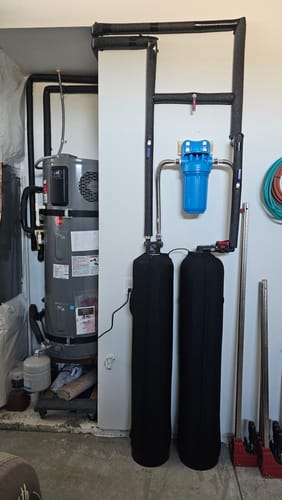
Once I committed to finding a solution, I dove deep into water treatment technologies. The options were overwhelming: reverse osmosis systems, carbon filters, UV sterilizers, water softeners, and combinations thereof.
My initial instinct was to install a simple under-sink reverse osmosis system for drinking water. However, after calculating the cost of multiple point-of-use systems throughout the house and considering that we still wanted better water for cooking, showering, and appliances, a whole house system made more sense.
I spent weeks researching different filtration media. Standard activated carbon removes chlorine and improves taste, but I learned that catalytic carbon is significantly more effective at removing chloramine – a disinfectant that some municipalities use instead of chlorine and is much harder to filter.
That's when I discovered bone char carbon, which was completely new to me. Unlike regular activated carbon made from coconut shells or coal, bone char is produced from animal bones and has a unique porous structure that's particularly effective at removing fluoride – something regular carbon filters can't accomplish.
The more I researched, the more I appreciated the sophistication required for effective whole house filtration. Flow rates needed to match our household demand (we calculated about 8-10 GPM during peak usage). The system needed to handle our water pressure without creating significant drops. And most importantly, it needed to actually remove the specific contaminants in our water supply.
I considered several system types:
Traditional activated carbon systems were the most affordable but wouldn't address fluoride or provide the contact time needed for thorough filtration at whole house flow rates.
Reverse osmosis systems would remove virtually everything but produce significant wastewater and couldn't practically handle whole house volumes.
Basic sediment and chlorine filters would improve taste but wouldn't address the comprehensive filtration I wanted.
Multi-stage systems offered thorough filtration but often required frequent maintenance and high ongoing costs.
The catalytic and bone char carbon combination appealed to me because it addressed multiple contaminant categories in a single system while maintaining reasonable flow rates and manageable maintenance requirements.
Why I Chose the SoftPro Catalytic Bone Char System
After weeks of research, several factors led me to SoftPro's upflow catalytic and bone char carbon filter.
First, the dual media approach made scientific sense. The catalytic carbon would handle chlorine, chloramines, and organic compounds, while the bone char specifically targeted fluoride and provided additional adsorption capacity. Having both media types in one tank seemed more efficient than multiple separate filters.
The upflow design was crucial for my application. Unlike downflow systems that can channel water through the media unevenly, upflow forces water through the entire filter bed, maximizing contact time and utilization of the filtration media. This design also prevents compaction of the media over time.
Flow rate specifications met our household needs perfectly. The system maintains 8-12 GPM flow rates depending on the tank size, which would handle our peak demand without pressure drops that would affect shower performance or appliance operation.
The backwash feature automatically cleans the media bed, extending its life and maintaining performance. This happens during programmed cycles when water demand is typically low, so it doesn't interrupt our daily routines.
SoftPro's reputation in the water treatment industry gave me confidence. They've been manufacturing systems for decades, and their technical support team could answer detailed questions about media specifications, system sizing, and expected performance with our specific water chemistry.
The complete kit approach eliminated guesswork. Everything needed for installation came in one package: the tank, media, control valve, bypass assembly, and all fittings. I appreciated not having to source components separately or worry about compatibility issues.
Certification was important to me. The NSF certification for both the components and the media types provided third-party verification of performance claims. The catalytic carbon meets NSF/ANSI Standard 42 for chlorine reduction, and the bone char meets drinking water grade standards.
Cost-wise, the system represented good value. While not the cheapest option, the media life expectancy of 5-7 years for typical household use meant reasonable ongoing costs compared to systems requiring annual filter replacements.
Unboxing and First Impressions

The system arrived in two packages via freight delivery. The main tank came secured on a small pallet, while the control valve and accessories shipped separately in a well-packed box.
Opening the main shipment, I was immediately impressed by the tank construction. The fiberglass-wrapped tank felt substantial and professional-grade, not like a cheap plastic housing. The 10-inch diameter and 54-inch height would fit in our utility room, though I'm glad I measured carefully during the planning phase.
The Clack control valve looked robust and came pre-programmed, though SoftPro included clear instructions for adjusting settings based on water usage patterns and hardness levels. The digital display and simple button interface seemed user-friendly, unlike some overly complicated control systems I'd seen on other brands.
All the plumbing components were included: bypass valve assembly, pressure relief valve, drain line fittings, and various adapters. The quality exceeded my expectations – heavy-duty brass fittings and high-quality valves that felt like they'd last for years.
The installation manual was thorough without being overwhelming. Clear diagrams showed multiple installation scenarios, and the troubleshooting section anticipated common questions. I particularly appreciated the section on system startup and initial programming.
One pleasant surprise was the pre-loaded media. I'd assumed I would need to add the catalytic carbon and bone char myself, but SoftPro ships the system with media already properly layered in the tank. This eliminated the messy and somewhat technical process of calculating media volumes and ensuring proper distribution.
Installation Experience: Easier Than Expected
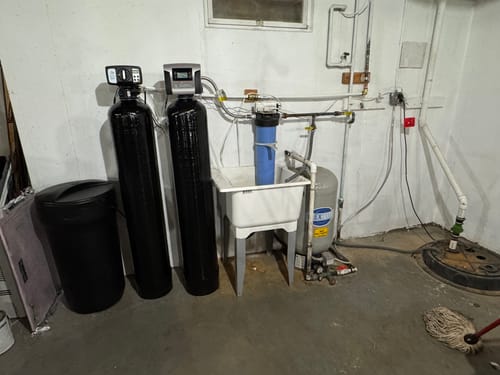
I chose to install the system myself, partly to save money but mostly because I wanted to understand exactly how everything worked. My plumbing experience is limited to basic repairs, so this was definitely stepping outside my comfort zone.
Pre-installation preparation took more time than the actual installation. I needed to locate the main water line, plan the bypass configuration, and ensure adequate space for the tank and future maintenance access. The utility room location I chose provided easy access to the electrical outlet needed for the control valve.
Shutting off the main water supply and draining the lines took about 30 minutes. I used a pipe cutter to create the installation point, then dry-fitted all the components before making any permanent connections. This preparation step saved significant time and prevented mistakes.
The bypass valve installation was straightforward but required attention to detail. The three-valve configuration allows complete isolation of the filter system for maintenance while maintaining water supply to the house. Getting the orientation correct was crucial – I double-checked the flow direction arrows multiple times.
Connecting the tank proved simpler than expected. The inlet and outlet ports are clearly marked, and the included fittings threaded on smoothly. I used thread sealant on all connections and tightened everything hand-tight plus one turn with a wrench, as recommended in the instructions.
The drain line connection required running a 1/2-inch tube to our utility sink, about 15 feet away. This was the most time-consuming part of the installation, but necessary for the automatic backwash cycles. The control valve needs to drain approximately 50-75 gallons during each regeneration cycle.
Electrical connection was simple – just plugging the transformer into a standard outlet. The low-voltage connection to the control valve snapped in place securely.
Initial startup involved opening the bypass valves gradually and checking for leaks. I was nervous about this step, but everything held perfectly. The system automatically began its startup sequence, and I could hear water flowing through the media bed as it displaced air and settled the filtration material.
Total installation time was about four hours, including preparation and cleanup. A professional installer could probably complete it in two hours, but taking my time allowed me to understand each component and connection thoroughly.
Performance Testing and Real-World Results
I was eager to test the system's performance, but SoftPro recommends running 100-200 gallons through initially to flush any dust from the media and fully condition the filtration bed. This took about a week of normal household use.
My first real test was simply tasting the water. The difference was immediately noticeable – the harsh chlorine taste was completely gone, replaced by clean, neutral-tasting water that reminded me of good bottled water. My wife commented on the improvement without me mentioning the new system, which was encouraging validation.
I tested the water with my TDS meter after two weeks of operation. The total dissolved solids dropped from 280 ppm to 195 ppm – not a dramatic reduction, but this was expected since carbon filtration doesn't remove all minerals, just the problematic ones affecting taste and odor.
More importantly, I purchased chlorine test strips to measure the specific contaminant I was most concerned about. Our incoming water consistently tested at 2.0-2.5 ppm chlorine, while the filtered water showed zero detectable chlorine. This was exactly the performance I hoped for.
The fluoride testing was more complex since test strips for fluoride are less reliable. I sent water samples to a local lab for analysis. The results showed fluoride reduction from 0.8 ppm to 0.2 ppm – about 75% removal, which aligned with the bone char media specifications.
Flow rate performance exceeded my expectations. I can run our dishwasher and washing machine simultaneously while taking a shower without any noticeable pressure drop. The 10 GPM flow rate capacity handles our peak demand easily.
Coffee taste improvement was dramatic. Using the same beans and brewing method, the coffee now tastes cleaner and brighter. The chlorine was apparently masking the subtle flavors I was paying extra to enjoy.
Shower water feels noticeably different – softer, though not in the same way as water softener-treated water. My wife's skin irritation disappeared within two weeks, and her hair feels less dry and brittle. We're using less conditioner and moisturizer, which is an unexpected cost savings.
Appliance performance has improved subtly but measurably. Our humidifiers no longer develop the white mineral film as quickly, and the coffee maker hasn't required descaling in six months of use.
Ongoing Maintenance and Operating Costs
One of my main concerns before purchasing was the ongoing maintenance burden and costs. Six months in, I'm pleased with how manageable everything has been.
The automatic backwash cycles occur every seven days by default, though this can be adjusted based on water usage and quality. These happen at 2:00 AM and take about 45 minutes to complete. I've never been awakened by the process, though I can hear water running if I'm up late.
Each backwash cycle uses approximately 60 gallons of water for cleaning and regenerating the media bed. At Cleveland's water rates, this costs about $0.30 per cycle, or roughly $1.25 monthly. This seemed reasonable given the system processes thousands of gallons between cleanings.
The control valve displays useful information including days since last regeneration, gallons processed, and flow rate. This data helps me understand our water usage patterns and confirm the system is operating correctly.
So far, I haven't needed to adjust any settings or perform manual maintenance beyond checking the display monthly. The bypass valves allow me to isolate the system if needed, but this hasn't been necessary.
SoftPro estimates the media life at 5-7 years for typical household use, depending on water chemistry and volume processed. At current usage rates, I'm processing about 1,000-1,500 gallons monthly, which puts me well within the expected range for maximum media life.
When media replacement is eventually needed, the cost will be approximately $400-500 for both the catalytic carbon and bone char. Spread over 5-7 years, this represents about $70-100 annually in media costs.
Electricity consumption is minimal – the control valve transformer draws about 8 watts continuously for the timer and display, costing roughly $8 annually at current electricity rates.
Comparing these costs to our previous bottled water purchases ($40 monthly), the system pays for itself in eliminated bottled water costs within the first two years, not counting the additional benefits to appliances, plumbing, and personal comfort.
Final Verdict: A Worthwhile Investment in Water Quality
Six months after installation, I'm genuinely satisfied with the SoftPro Catalytic Bone Char Carbon system. The water quality improvement has exceeded my expectations, and the operational aspects have been refreshingly trouble-free.
What would I tell someone considering this system?
First, understand your specific water quality issues through testing. This system excels at removing chlorine, chloramine, fluoride, and taste/odor problems, but it's not a universal solution for all water quality issues.
The installation is manageable for someone with basic plumbing skills and the right tools, but don't hesitate to hire a professional if you're uncomfortable with any aspect. The system's performance depends on proper installation, particularly the bypass configuration and drain line routing.
Budget for the complete cost including installation supplies if you're doing it yourself, or professional installation if not. The system price is just part of the total investment.
Plan your installation location carefully. The tank is substantial, and you'll need periodic access for any future maintenance. Adequate drain access is crucial for the backwash cycles.
This system works best for households with municipal water supplies that use chlorine or chloramine disinfection and fluoride addition. Well water users or those with bacterial contamination issues would need different or additional treatment approaches.
The ongoing costs are reasonable but real. Factor the electricity, backwash water usage, and eventual media replacement into your long-term budget planning.
For our specific situation in Cleveland with typical municipal water issues, this system has delivered exactly what I hoped for: clean-tasting water throughout the house without the expense and waste of bottled water. The peace of mind knowing we're reducing our exposure to unnecessary chemicals while improving the everyday experience of cooking, drinking, and bathing has made this a worthwhile investment.
Would I purchase this system again knowing what I know now? Absolutely. The combination of performance, reliability, and reasonable operating costs makes it an excellent solution for comprehensive whole house water improvement.