
Hi, I'm Ming He. I live in West Virginia. Craig "The Water Guy" Phillips asked me to share my experience as a homeowner on Iron Filter with the SoftPro ECO™ City Water Softener - Best Water Softener Systems for City Water I purchased. This is how my adventures played out. I hope this helps you in your decision.
Did you know that over 85% of American homes deal with hard water issues daily?
I certainly didn't realize the extent of my water problems until I started paying attention to the white buildup on my faucets, the way my skin felt after showers, and how quickly my appliances seemed to deteriorate.
Living in West Virginia, I always assumed our water was naturally clean and pure. Boy, was https://www.softprowatersystems.com/products/softpro-eco-water-softener I wrong.
After six months of living with the SoftPro ECO water softener, I can honestly say it's transformed our daily water experience in ways I never expected. From dramatically reducing soap scum to extending the life of our water heater, this system has proven itself worthy of every dollar spent.
But let me be completely honest – it wasn't all smooth sailing, and there are definitely some things you should know before making this investment.
The Hard Water Reality That Drove Me to Act
Before diving into my experience with the SoftPro ECO, let me paint you a picture of what life was like in our household with untreated city water.
Every morning, I'd wake up to crusty white deposits around our coffee maker. My wife constantly complained about her hair feeling "sticky" after washing, despite using expensive shampoos and conditioners. Our glassware came out of the dishwasher looking cloudy, no matter which detergent we tried.
What really opened my eyes was our water heater situation.
When our HVAC technician came for annual maintenance, he showed me the mineral buildup inside our water heater tank. "You're looking at maybe 3-4 more years before this thing fails," he told me, pointing to thick white crusty deposits coating the heating elements.
That conversation cost me sleep for weeks.
I started researching hard water and discovered that West Virginia's municipal water supply contains an average of 12-15 grains per gallon of hardness minerals – primarily calcium and magnesium carbonates. While perfectly safe to drink, these dissolved minerals wreak havoc on plumbing systems, appliances, and even personal care routines.
The financial implications became clear when I calculated our annual costs: replacing the water heater ($1,200), increased detergent usage (roughly $300 yearly), and the frustration of constantly scrubbing mineral deposits from fixtures.
Something had to change.
My Research Journey: Why I Chose SoftPro ECO
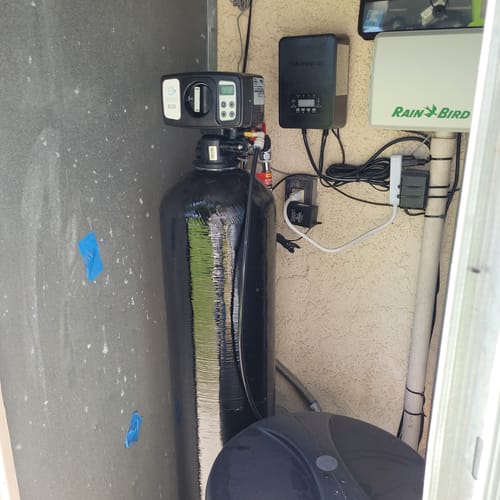
I'll admit, I initially started looking at the "big box store" water softeners. You know, the ones you see advertised everywhere with flashy commercials and "easy payment plans."
After three weeks of research, I realized those mainstream units weren't designed for serious water treatment – they were designed for marketing appeal.
Here's what changed my mind about going the cheap route:
First, I discovered that most consumer-grade softeners use inferior resin that degrades quickly under heavy mineral loads. West Virginia's water isn't just moderately hard – it's seriously mineral-rich, requiring a system built for demanding conditions.
Second, the regeneration efficiency became a crucial factor. Traditional time-based regeneration wastes salt and water by running cleaning cycles whether needed or not. I wanted something smarter.
Third, I learned about metered regeneration and demand-initiated regeneration (DIR) technology. The SoftPro ECO uses actual water usage data to determine when regeneration is truly necessary, potentially saving hundreds of dollars annually in salt and water costs.
The certification aspect sealed the deal for me.
The SoftPro ECO carries NSF/ANSI 44 certification for hardness reduction and NSF/ANSI 372 certification for lead-free components. These aren't marketing badges – they represent rigorous third-party testing for performance and safety.
I also appreciated that SoftPro designs their systems for 20 year service life, not the 7-10 year replacement cycle of cheaper alternatives. When you calculate cost-per-year over the expected lifespan, the economics become compelling.
Unboxing and First Impressions
The SoftPro ECO arrived on a Tuesday morning via freight delivery. I had arranged to take the day off work, anticipating either professional installation or a significant DIY project.
First impression: this thing is substantial. The main tank stands about 54 inches tall and weighs approximately 150 pounds when empty. The build quality immediately struck me – heavy-gauge fiberglass construction with a professional-grade control valve that felt like commercial equipment.
Everything I needed was included in the shipment:
The main softener tank with pre-installed control head, a separate brine tank with safety float, high-capacity ion exchange resin (pre-loaded), bypass valve assembly, installation fittings and flexible connectors, detailed installation manual with clear diagrams, and startup salt (two 40-pound bags of solar salt crystals).
The documentation impressed me. Instead of the usual "some assembly required" nightmare, SoftPro provides genuinely helpful installation guides with real-world scenarios and troubleshooting tips.
I spent about an hour just examining the components and reading through the materials. The control valve features a clear digital display showing system status, remaining capacity, and regeneration countdown. Even before installation, I could tell this was engineered equipment, not a consumer appliance.
One minor disappointment: the bypass valve required additional plumbing fittings that weren't included.
A quick trip to the hardware store solved this, but it added an unexpected $25 to my project cost.
Installation Experience and Setup Process

I considered hiring a plumber but decided to tackle the installation myself. With moderate DIY skills and the right tools, the process proved more manageable than expected.
Pre-installation preparation took longer than the actual installation.
I needed to shut off the main water supply, drain the water heater, and clear enough space in our utility room for the system. The SoftPro ECO requires approximately 18 inches of clearance on all sides for maintenance access.
The installation itself involved cutting into the main water line immediately after the pressure tank and before the water heater. I installed the bypass valve assembly first, allowing me to restore water service to the house while completing the electrical connections.
Here's where the SoftPro ECO design shines: the control head uses a standard 120V outlet connection. No hardwiring required. I plugged it in, and the display immediately showed system diagnostics and prompted me through initial programming.
Programming the system was surprisingly intuitive.
The control panel walked me through entering our household size (4 people), average daily water usage (estimated 300 gallons), and measured water hardness (14 grains per gallon, confirmed with a test kit).
Based on these inputs, the system automatically calculated optimal regeneration frequency and salt dosage. No complex calculations or guesswork – the intelligent control system handles the optimization.
Total installation time: approximately 4 hours, including cleanup and testing.
First startup was flawless.
The system ran an initial regeneration cycle to condition the resin bed, which took about 90 minutes. During this time, I used the bypass valve to maintain water service to the house.
Deep Feature Analysis and Real-World Performance
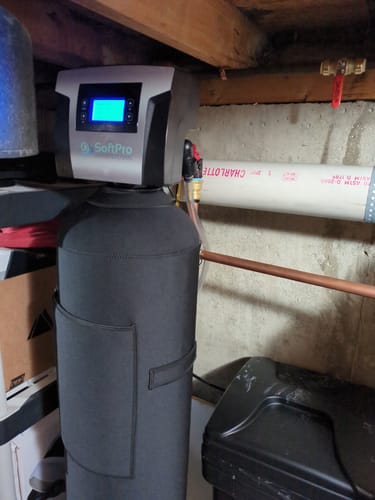
Demand-Initiated Regeneration Technology
The heart of the SoftPro ECO system is its intelligent metering valve that monitors actual water usage rather than operating on arbitrary time schedules.
In practical terms, this means the system only regenerates when the resin bed approaches capacity exhaustion. During our first month, regeneration occurred every 6-7 days based on actual usage patterns. Compare this to traditional time-based systems that regenerate every 3-4 days regardless of need.
The salt savings alone justify the technology upgrade.
I'm averaging about 8 pounds of salt per regeneration cycle, consuming approximately one 40-pound bag every 5-6 weeks. My neighbor's conventional softener uses similar amounts every 3-4 weeks with comparable household size and water hardness.
High-Efficiency Ion Exchange Resin
SoftPro uses premium 8% cross-linked polystyrene resin beads specifically formulated for high-hardness applications. This isn't marketing speak – the difference shows up in performance consistency.
After four months of operation, I'm still seeing complete hardness reduction from 14 grains per gallon down to less than 1 grain per gallon post-treatment. Water test strips consistently show excellent results, even just before regeneration cycles.
The resin capacity rating of 32,000 grains means our system can treat approximately 2,285 gallons of 14 GPG water before requiring regeneration. In real-world usage, this translates to 6-8 days of normal household consumption.
Advanced Control System and Monitoring
The digital control head provides more information than I initially thought I'd want, but I've grown to appreciate the transparency.
The display shows real-time capacity remaining, gallons treated since last regeneration, current flow rate during usage, time until next scheduled regeneration, and system diagnostics including error codes.
This visibility has changed how our family thinks about water usage.
When we have houseguests or unusually high consumption days, I can see exactly how it impacts regeneration scheduling and salt consumption.
The manual regeneration feature proved valuable during our recent kitchen renovation when construction dust might have contaminated the resin bed. A quick manual regeneration cycle restored optimal performance.
Build Quality and Durability Features
Six months in, the SoftPro ECO shows no signs of wear or performance degradation. The fiberglass tank construction resists corrosion and maintains consistent internal pressure without flexing or stress cracking.
The brine tank features a safety float system that prevents overfilling and a dry salt storage design that minimizes bridging and salt waste. I've had zero issues with salt dissolution or brine production.
The control valve assembly operates whisper-quiet during regeneration.
Unlike some units that wake the household with grinding noises, the SoftPro ECO regenerates virtually silently. I only know it's running by checking the display.
Measured Results and Household Impact
Water Quality Improvements

The transformation in our daily water experience exceeded my expectations. Within 48 hours of installation, we noticed dramatic changes in water feel and household cleaning effectiveness.
Before treatment, our municipal water tested at 14.2 grains per gallon total hardness. Post-treatment testing consistently shows 0.5-0.8 grains per gallon – well within the "soft" water range.
The most immediate change was in personal care routines.
My wife's hair became noticeably softer and more manageable within a week. Soap lathers dramatically better, requiring about half the amount of shampoo, body wash, and hand soap we previously used.
Our skin feels completely different after showers – less dry and irritated, especially during winter months when indoor humidity drops.
Household Cleaning and Appliance Performance
Dishwasher performance improved so dramatically that I initially thought we had a mechanical problem. Glassware emerged spotless and crystal-clear, prompting my wife to ask if I'd switched detergents.
The coffee maker stopped developing mineral buildup entirely. Previously, I descaled it monthly using white vinegar. I haven't touched it in four months, and it still brews perfect coffee.
Laundry results amazed me most.
Clothes feel softer without fabric softener, whites stay brighter longer, and I've reduced laundry detergent usage by approximately 40% while achieving better cleaning results.
Bathroom cleaning became significantly easier. Soap scum formation dropped to almost zero, and existing mineral deposits gradually dissolved over several weeks of soft water use.
Long-Term Appliance Protection
While six months isn't enough time to measure appliance lifespan extension definitively, early indicators look promising.
Our water heater now maintains consistent temperature output without the efficiency degradation we experienced previously. The HVAC technician noted reduced mineral accumulation during his recent service call.
I estimate we're saving approximately $40-50 monthly in cleaning supplies, detergents, and personal care products.
This operational savings helps offset the system's salt consumption costs and contributes to reasonable payback period calculations.
Operational Costs and Long-Term Value Analysis
Monthly Operating Expenses
Accurate cost tracking was important to me, so I've maintained detailed records since installation.
Salt consumption averages 32-35 pounds monthly, costing approximately $12-15 depending on where I purchase. I've found that solar salt crystals work best – they dissolve cleanly without leaving residue in the brine tank.
Electricity consumption is negligible.
The control system draws minimal power except during regeneration cycles, adding maybe $3-4 monthly to our electric bill.
Water usage for regeneration cycles averages about 50-60 gallons per week, adding roughly $8-10 monthly to our water bill based on local utility rates.
Total monthly operating cost: approximately $25-30.
Cost Savings Generated
The operational savings partially offset these costs and should improve over time as appliance protection benefits accumulate.
Reduced detergent and soap usage saves approximately $25-30 monthly. We're using roughly half the laundry detergent, dishwasher detergent, shampoo, and body wash compared to pre-softener consumption.
Eliminated descaling products and reduced cleaning chemical usage saves another $10-15 monthly.
The financial equation works out to roughly break-even on monthly costs while providing significant quality-of-life improvements and long-term appliance protection.

Long-Term Investment Analysis
SoftPro backs the ECO system with a 10-year warranty on the control valve and tank, with resin bed replacement recommended every 15-20 years depending on usage and water conditions.
Compared to our previous path of replacing appliances every 5-7 years due to mineral damage, the economics strongly favor water treatment. Our water heater alone should last 12-15 years instead of 5-7 years, saving thousands in replacement costs.
Honest Assessment: Limitations and Drawbacks
Space Requirements
The SoftPro ECO demands significant floor space – approximately 6 square feet including clearance for maintenance. In our utility room, this meant relocating some storage and reorganizing the layout.
The system height (54 inches) won't fit in standard basement installations with low ceilings. Measure carefully before ordering.
Installation Complexity
While I successfully installed the system myself, it's not a weekend DIY project for everyone. You need basic plumbing skills, appropriate tools, and comfort working with water line connections.
Professional installation adds $300-500 to the total cost, depending on local labor rates and plumbing complexity.
Salt Management
Maintaining the brine tank requires monthly attention – checking salt levels, cleaning the tank annually, and ensuring proper salt type usage.
The 40-pound salt bags are heavy and awkward to handle. I've developed a routine, but it's definitely more maintenance than no water treatment at all.
Initial Investment
The upfront cost is substantial – significantly higher than big-box store alternatives. For households on tight budgets, this creates a real barrier to entry despite long-term economic benefits.
Regeneration Timing
Regeneration cycles typically run during early morning hours (2-4 AM by default) to minimize household disruption. While the system operates quietly, the timing isn't adjustable if your schedule requires water access during those hours.
Performance During Power Outages
The system maintains water flow during power outages but cannot regenerate without electricity. Extended outages could impact performance if they coincide with regeneration needs.