
Hi, I'm Roger M.. I live in Phoenix. Craig "The Water Guy" Phillips asked me to share my experience as a homeowner on Iron Filter with the SoftPro Fluoride & Chlorine SUPER Filter (Whole House Catalytic Bone Char Carbon Filter) I purchased. This is how my adventures played out. I hope this helps you in your decision.
Did you know that the average American household consumes over 80 gallons of water daily, yet most of us have no idea what's actually flowing through our pipes?
That was exactly my situation six months ago. Living in Phoenix, I'd grown tired of the strong chlorine smell coming from our taps and the lingering taste that made even my morning coffee unpalatable.
After researching whole house filtration systems for weeks, I decided on the SoftPro Fluoride & Chlorine SUPER Filter with its combination of catalytic and bone char carbon technology. The installation process taught me more about water filtration than I ever expected to learn, and the results have been genuinely impressive.
In this detailed review, I'll walk you through my complete experience – from the research phase and installation challenges to the daily performance and long-term costs I've observed. I'll share the specific improvements I've measured, the maintenance requirements I've discovered, and the honest limitations I've encountered along the way.
The Water Quality Problems That Pushed Me to Act
Living in Phoenix means dealing with heavily treated municipal water. The chlorine levels here are aggressive – necessary for safety, but absolutely brutal on taste and smell.
Every morning, I'd turn on the kitchen faucet and get hit with that swimming pool aroma. My wife started buying bottled water for drinking, which was costing us nearly $40 monthly. Our teenage daughter complained that showers left her skin feeling dry and itchy, despite using expensive moisturizers.
But the real wake-up call came when I noticed our stainless steel appliances developing water spots that wouldn't come off with regular cleaning. The dishwasher was leaving a film on glassware, and I could actually taste the treatment chemicals in ice cubes.
I tested our water with a basic TDS meter and found readings around 380 parts per million – not dangerous, but definitely on the higher side for dissolved solids. The chlorine smell was so strong that I knew the residual chlorine levels had to be well above the EPA's recommended maximum of 4 parts per million for taste and odor.
What really concerned me was learning about chloramine – a more persistent disinfectant that Phoenix Water Services had started using.
Unlike regular chlorine, chloramine doesn't dissipate by letting water sit out overnight. It requires specific filtration technology to remove effectively, and I realized that's why our water issues seemed to be getting worse over time.
My Research Journey Into Whole House Carbon Filtration
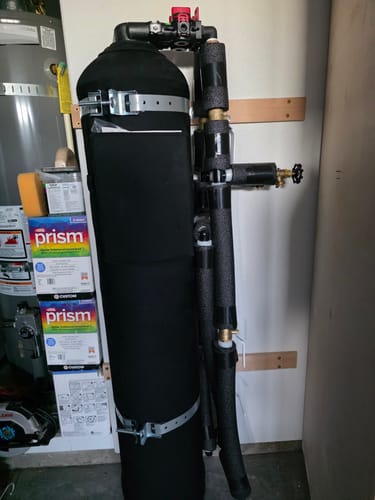
I spent nearly three weeks researching water filtration options, and the learning curve was steep. Initially, I thought all carbon filters were basically the same – just different sizes and price points.
That assumption got corrected quickly when I started diving into the technical differences between catalytic carbon and standard activated carbon. Regular carbon works well for chlorine, but chloramine requires the enhanced surface area and chemical properties of catalytic carbon.
The bone char component was something entirely new to me. I discovered it's particularly effective at removing fluoride and certain heavy metals – contaminants that standard carbon struggles with. Since Phoenix adds fluoride to municipal water, this seemed like valuable additional protection.
I looked at several upflow designs because they offer better contact time and more efficient backwashing compared to downflow systems. The upflow configuration means water enters at the bottom, flows up through the media bed, and exits at the top – allowing for better expansion of the carbon bed during filtration.
What sold me on the SoftPro system was the combination of catalytic carbon and bone char in a single vessel with upflow design.
Many competitors require separate tanks for different media types, which means more space, more plumbing, and higher maintenance complexity. The SoftPro unit promised to handle chlorine, chloramine, fluoride, and various organic compounds in one streamlined system.
The capacity rating of 600,000 gallons seemed appropriate for our household of three, giving us approximately 3-4 years of service life based on our estimated annual usage of 150,000 gallons.
Unboxing and First Impressions of the System
The SoftPro filter arrived via freight delivery on a pallet, which immediately told me this was serious equipment. The main tank measured 10 inches in diameter by 54 inches tall – larger than I'd anticipated, but manageable for our utility room space.
Build quality impressed me right away. The fiberglass reinforced tank felt substantial and professional-grade, not like the plastic housing I'd seen on some residential units. The control valve was clearly a quality component – heavy brass construction with clear labeling on all ports.
The media came separately in sealed bags: 1.5 cubic feet of catalytic carbon and 0.75 cubic feet of bone char carbon. Both media types had that distinctive activated carbon appearance – small, irregular black granules with what looked like tremendous surface area.
Documentation was thorough, including detailed installation diagrams, media loading instructions, and startup procedures. I appreciated that they included recommended plumbing configurations for different scenarios – bypass valve placement, drain requirements, and electrical considerations for the control valve.
One pleasant surprise was the inclusion of a media funnel and loading tube – small details that showed they'd actually thought about the installation process.
My only minor disappointment was that the bypass valve assembly wasn't included. I'd assumed it would come with everything needed for installation, but learned I needed to purchase the bypass separately or use individual ball valves.
Installation Experience and Lessons Learned

I decided to tackle the installation myself, having done basic plumbing projects before. This turned out to be more involved than I expected, but definitely manageable for someone comfortable with pipe work.
The first challenge was location. The unit needed to be positioned where I could access it for maintenance, close enough to the main water line for efficient plumbing, and with adequate drainage for backwashing. I settled on a corner of our utility room, about six feet from where the main line enters the house.
Installing the bypass valve assembly took most of my time. I used three full-port ball valves – inlet, outlet, and bypass – which gives me complete control over water flow for maintenance. The key is positioning everything so you can isolate the filter while maintaining water service to the house.
Loading the media required patience and the right technique.
I placed the bone char carbon in the bottom third of the tank, followed by the catalytic carbon on top. The loading tube was essential for preventing media from hitting the internal distributor and potentially damaging it. Taking time to level each layer as I went prevented channeling issues later.
The control valve programming was straightforward once I understood the sequence. I set it for a seven-day backwash cycle initially, planning to adjust based on actual performance. The backwash uses about 150 gallons and takes roughly 45 minutes to complete.
Initial startup revealed my first real lesson: carbon fines are inevitable and require thorough flushing. I ran water through the system for about 30 minutes before it cleared completely. As the review I'd read mentioned, I had to clean carbon particles out of several faucet aerators after the first few days of operation.
Performance Testing and Real-World Results
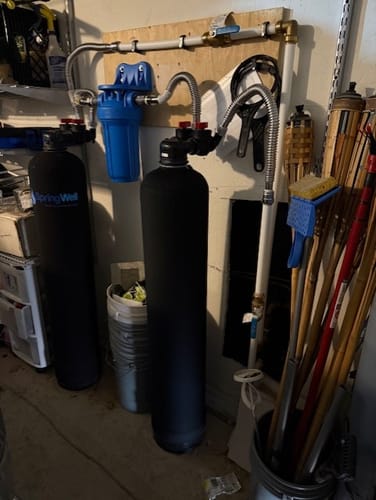
The difference in water quality was noticeable within hours of startup. The chlorine smell disappeared completely – something I could detect immediately when washing dishes or taking showers.
I conducted before-and-after testing using both basic test strips and a more accurate digital meter. Pre-filtration, our water measured 1.8 parts per million free chlorine and 2.1 parts per million total chlorine (indicating chloramine presence). Post-filtration readings showed non-detectable levels for both parameters.
TDS reduction was modest but measurable – dropping from 380 ppm to 340 ppm. This made sense since carbon filtration primarily targets organic compounds and treatment chemicals rather than dissolved minerals. The 40-point reduction likely represents the removal of chlorination byproducts and organic matter.
The taste improvement was dramatic and immediate.
Coffee, tea, and even plain drinking water had a clean, neutral flavor without any chemical aftertaste. My wife stopped buying bottled water within two weeks, saving us approximately $40 monthly in grocery costs.
Shower quality improved noticeably as well. The absence of chlorine eliminated that dry, tight feeling on skin and hair. My daughter mentioned that her hair felt softer and less brittle after washing – something I hadn't anticipated as a benefit.
Ice cubes became crystal clear and odorless. Previously, ice had a slight cloudiness and would sometimes carry that chlorine smell, especially if left in the freezer for more than a few days.
Ongoing Maintenance and Operational Costs
The automated backwash cycle has worked flawlessly since installation. Every seven days, the system runs through its regeneration sequence, using approximately 150 gallons of water and taking Fluoride Filtration about 45 minutes to complete.
I initially worried about the water usage for backwashing, but calculated it represents less than 2% of our total household consumption. At Phoenix water rates of roughly $4 per thousand gallons, each backwash costs about 60 cents.
The system requires no consumables like salt or chemicals – just the eventual replacement of carbon media after 3-4 years of service. Based on current pricing, a complete media change will cost approximately $300-350 in materials.
Maintenance tasks are minimal but important.
I check the control valve display monthly to ensure proper operation and verify that backwash cycles are completing normally. The digital readout shows days remaining until the next regeneration and indicates any service alerts.
Every six months, I test a few faucet aerators for carbon fines – residual particles can occasionally work loose from the media bed. This hasn't been a significant issue, but it's worth monitoring.
Pressure loss across the system has been negligible. I measured 2-3 PSI reduction at full flow, which is barely noticeable during normal household usage. Even with multiple fixtures running simultaneously, water pressure remains strong throughout the house.
Real-World Impact on Daily Life
The most immediate change was eliminating our bottled water purchases. Within a month, we'd recouped nearly 15% of the system cost just through grocery savings. More importantly, we reduced plastic waste significantly – something that felt good environmentally.
Cooking and beverage preparation improved noticeably. Soups, pasta water, and rice all tasted cleaner without that underlying chemical flavor. Even simple things like brushing teeth became more pleasant without that chlorine aftertaste.
Our dishwasher performance improved as well. Glassware comes out clearer, and we've reduced rinse aid usage because water spots are less problematic. The absence of chlorine seems to help our dishwasher detergent work more effectively.
Laundry benefits surprised me.
Clothes feel softer and colors appear more vibrant. White garments stay whiter longer, and I believe the removal of chlorine helps preserve fabric integrity over time. We've reduced fabric softener usage because clothes naturally feel less stiff.
Shower and bath quality transformed the daily routine for our whole family. Skin feels less dry, hair is more manageable, and we're using less body lotion and hair conditioner. These aren't dramatic changes, but they're consistent and noticeable.
House guests have commented on the water quality without prompting. Several friends mentioned that our water tastes "clean" or "refreshing" compared to their own tap water – external validation that the improvements are real and significant.
Honest Assessment: Limitations and Considerations
While I'm satisfied with the system overall, there are some limitations worth discussing. The upfront cost is substantial – around $1,200 including installation supplies. This isn't an impulse purchase, and the payback period extends several years even with bottled water savings.
Space requirements might be challenging for smaller homes. The 54-inch tank height requires adequate clearance, and you need accessible drainage for backwashing. Our utility room accommodated it easily, but I can see this being difficult in cramped installations.
The system doesn't address hard water issues. If you have significant calcium and magnesium problems, you'll still need separate water softening equipment. Carbon filtration focuses on chemical and organic contaminant removal, not mineral content.
Media replacement will be a significant maintenance event every 3-4 years.
While not complicated, it requires draining the system, removing old media, and reloading fresh carbon. You can hire a service technician, but expect to pay $200-300 in labor costs on top of media expenses.
Backwash water discharge needs proper drainage. The regeneration cycle produces 150 gallons of waste water that must go somewhere appropriate. If your utility room lacks floor drainage, you'll need additional plumbing work.
The control valve requires electrical power. During power outages, the system continues filtering but can't perform automated backwash cycles. Extended outages might require manual regeneration once power returns.